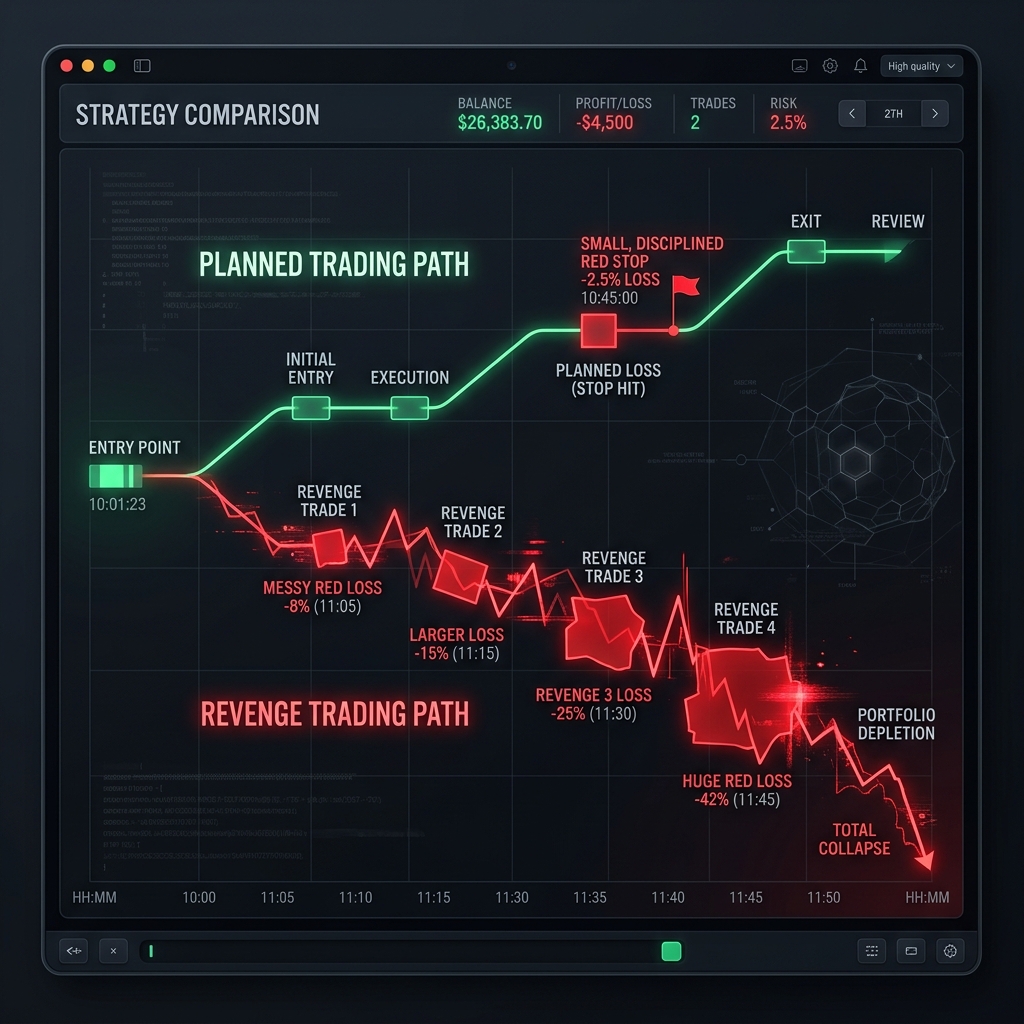
How One Angry Trade Destroys Your Week
The First Loss Was Business. The Second Loss Was Behavior.
Most traders know they revenge trade. But very few know the actual cost. Not the feeling. Not the guilt. The exact amount.
This page is not about motivation. It is about measurement.
Planned Loss Path
Discipline first
Revenge Day Path
Behavior breakdown
The Revenge Trade Cost Calculator
Use our interactive calculator below to model the exact financial leakage caused by emotional re-entries. Drag the sliders to match your own account parameters and see the compounding effect of behavior-driven trades.
Revenge Trade Cost Calculator
Your Inputs
The Real Damage
A revenge trade does not only lose money. It also exponentially increases the target you need to recover.
The revenge trade is not always obvious
A revenge trade does not always look wild.
Sometimes it looks like a clean setup.
Sometimes it even wins.
That is why it is dangerous.
The question is not: “Did the trade make money?”
The question is: “Would I have taken this trade if I was not trying to recover?”
A trader can win a revenge trade and still damage their process. That win teaches the brain a very bad lesson: emotional trading can work.
That is how the habit becomes stronger.
Why revenge trading feels logical
After a loss, your brain wants closure. It wants to remove the pain quickly.
So it starts creating arguments:
- "The market is still moving."
- "I just got stopped because of bad timing."
- "This next trade is better."
- "I will use bigger size and recover faster."
- "After this, I will stop."
In the moment, these thoughts feel logical. But most of them are not analysis. They are pain management.
The market did not improve. Your emotional pressure increased. That is the real difference.
Loss
Standard business cost
Frustration
Ego triggers
Urge to Recover
Patience breaks
Bigger Size
Risk rules bypassed
Bigger Loss
The spiral deepens
"Revenge trading is a loop. The goal is to break the loop before the second trade."
The 30-minute revenge test
Before entering another trade after a loss, ask four questions:
- Would I take this trade if I was green today?
- Is my size the same as my normal planned size?
- Is this setup already in my playbook?
- Am I entering because of opportunity or because of discomfort?
If even one answer is weak, wait 30 minutes.
Not because 30 minutes is magical. Because revenge trading needs speed. If you slow it down, the emotional charge becomes weaker.
“Would I take it if I was green?” Decision Card
Self-audit your next trade BEFORE entering. It separates market opportunity from the emotional urge to recover.
High risk of behavior-driven entry. You are bypassing your rules to recover a loss. Stop and step away for 30 minutes.
How to calculate your real revenge-trade cost
Use your last 20–50 trades. Tag a trade as “revenge” if it matches two or more:
- Taken within 30 minutes of a loss
- Size larger than normal
- Setup not planned
- Entered to recover
- Stop moved or ignored
- Trade taken after daily loss limit was hit
Now compare:
| Category | Result (₹) | Discipline Impact |
|---|---|---|
| All Trades | -₹12,000 | Net monthly loss |
| Non-Revenge Trades | +₹6,500 | Profitable strategy |
| Revenge Trades | -₹18,500 | Discipline leak |
This trader does not have a strategy problem first. This trader has a revenge-trade filter problem.
The point is simple: separate strategy losses from behavior losses.
The rule that actually works
Do not create a vague rule like: "I will stop revenge trading."
That rule is useless because it depends on willpower. Create a mechanical rule:
Mechanical Rule:
"After any full stop-loss trade, I cannot take another trade for 30 minutes unless the setup was written before the loss happened."
Even better:
Mechanical Rule:
"If I take two losses in a day, my size drops by 50% for the next trade."
This works because it does not ask your emotional brain to be wise. It removes the decision when you are most likely to make a bad one.
Self-Audit Checklist
0 / 6 FlaggedTry this audit:
Take your last 30 trades. Mark every trade taken after a loss. Compare the P&L of those trades against the rest.
If the number shocks you, that is not failure. That is the first clean map of the problem.